
How to organize family finances: a practical, step-by-step guide
Organizing family finances takes no secret formula and no monk-like discipline: it takes a simple method that fits the routine of people who work, run a home and would rather not spend Sunday inside a spreadsheet. This guide walks that method from the start to the month-end close — you can apply it on paper, in any tool, or in ClariFin.
The path has six steps: diagnosis, a map of income and expenses, organizing accounts and cards, defining who is responsible, a budget with priorities, and a short follow-up routine. At the end, a worked example with full numbers and a checklist to start today.
1. Start with the diagnosis: where the money is going
Before deciding where money SHOULD go, find out where it IS going. Take the last 2 or 3 months of statements and card bills and sort every expense into a few categories: housing, food, transport, health, education, leisure, debt. You do not need surgical precision — you need an honest picture.
Two questions guide this step: how much comes into the household every month, adding every income? And how much goes out, adding everything — including installments already committed for the coming months? If the second answer is bigger than the first, the diagnosis has already named priority number one.
Do this together, without a judging tone. The goal is not to find who is guilty for Tuesday’s delivery — it is to see the pattern. Invisible spending cannot be corrected; visible spending can.
2. Separate income, fixed expenses and variable expenses
With the diagnosis in hand, organize the numbers into three blocks. Income: salaries, freelance work, rent received, pensions — everything that comes in regularly. Fixed expenses: they repeat every month at the same or a very similar amount (rent or mortgage, condo fees, school, insurance, subscriptions). Variable expenses: they happen every month, but the amount moves (groceries, transport, pharmacy, leisure).
This separation matters because each block asks for a different strategy. Fixed ones are renegotiated or cut for good — change the plan, cancel the forgotten subscription, renegotiate the contract. Variable ones are managed with a ceiling: an agreed amount per category, tracked through the month.
If the household income is variable (self-employed, commissions), flip the logic: build the budget on the realistic floor of recent months, not on the average. In months above the floor, the difference goes to savings — not to the standard of living.
3. Accounts, cards, bills and installments in a single map
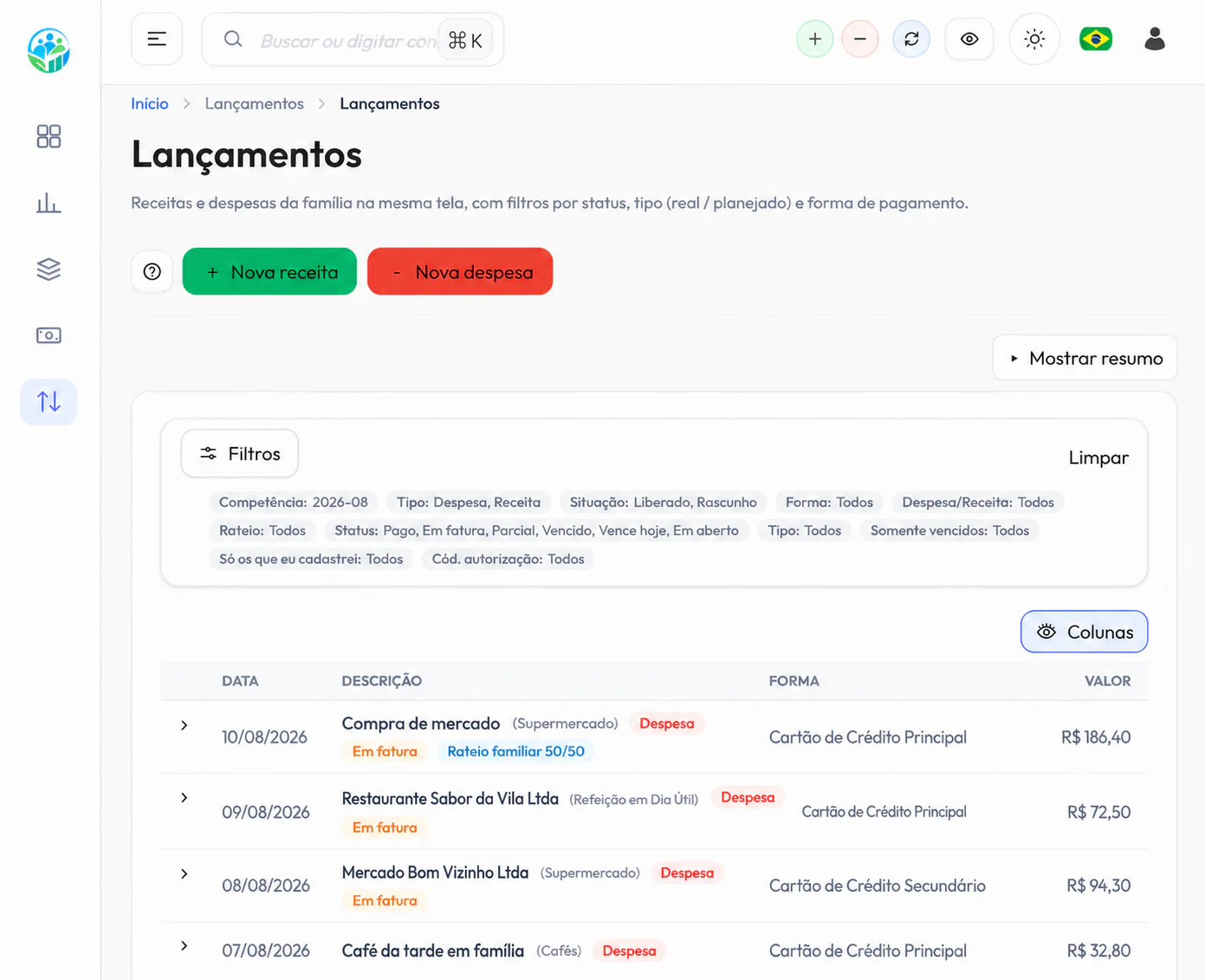
Most families do not lose track of the rent — they lose track of what is scattered: two or three cards, installment plans that cross the year, accounts at different banks. The third step is putting it all in one map: which accounts exist, which cards, what is due on which day, and how many installments are left on each purchase.
Installments deserve special attention: they are a fixed expense in disguise. Adding up everything already committed shows how much of the coming months is already spoken for — before any new purchase. A healthy rule of thumb: before splitting a purchase into installments, check whether the existing installments plus the new one fit inside the ceiling the family agreed on.
Write down the due date of every bill and card too. A late payment out of forgetfulness is the silliest cost there is: it becomes interest and penalty with nothing in return.
4. Define who takes care of what
Family finance is a team game, and a team without defined positions concedes silly goals. For each household bill, define two distinct things: who PAYS (which account or card the money leaves from) and who TAKES PART (who bears that expense in the family settlement, and in what proportion).
The split can be fifty-fifty, proportional to each income, or specific per expense — school only on the parents, streaming shared with the child who works. What does not work is autopilot: one person paying everything, the other with no visibility, and the money conversation happening only when it runs short.
If splitting between the two of you is the sensitive point at home, the guide on financial control for couples (in the content hub) goes deeper into that: splitting models, privacy and the settlement.
5. Build the budget around the family’s priorities
A budget is not a list of bans — it is a decision made in advance. With the numbers from the previous steps, decide together: how much goes to fixed expenses, what the ceiling is for each group of variable ones, and — before anything is left over — how much goes to the emergency fund and to the family’s goals (a trip, a new car, a home down payment).
The order matters: savings and goals enter as a commitment of the month, not as leftovers. If money only shows up when it happens to be left, it never is. Start with what is realistic — even 5% of income — and grow it as the fixed expenses shrink.
Priorities belong to the family, not to the app or the guide: a household that values leisure cuts a subscription; one that values study cuts leisure. The method only makes sure the choice is a conscious one.
6. A short weekly routine and the monthly close
What keeps the organization standing is not the plan — it is the routine. And it can be short: log expenses as they happen (it takes seconds) and hold a ten-minute weekly check-in: what was spent, how the variable ceilings look, what is due next week.
Once a month, the close: check that card bills match what was logged, look at each category against the agreed ceiling, settle the differences between the people at home (whoever paid more than their share receives the difference) and adjust next month’s budget with what you learned.
The close is also the moment for the good money conversation: with numbers on the table, the discussion moves from "you spend too much" to "that ceiling was too tight, should we adjust it?".
7. A worked example: one month from start to close
Marina and Rafael earn 10,000 together (she 6,000, he 4,000) and agreed on a proportional split: 60% and 40%. In the diagnosis they mapped fixed expenses of 5,100 (rent 2,200, utilities 800, school 1,200, health plan 900), variable ones with a ceiling of 2,300 (groceries 1,400, transport 500, leisure 400) and 550 of ongoing installments (sofa 300, 4 of 10; laptop 250, 8 of 12).
Total committed: 7,950. Out of the 2,050 difference, they decided that 1,500 goes to the emergency fund at the start of the month, and 550 stays as slack for the unexpected.
Through the month, each logged what they paid. At the close: Marina had paid 4,900 of the household expenses and Rafael 3,050. Under the 60/40 rule, Marina’s share would be 4,770 and Rafael’s 3,180 — so Rafael transfers 130 to Marina and the month balances, with no discomfort and no notebook.
The next month the couple noticed the grocery ceiling had been exceeded by 180 three months in a row. Instead of arguing with reality, they raised the ceiling to 1,550 and reduced the slack — a good budget describes real life, it does not pretend an ideal one.
8. A checklist to start today
If this guide turned into a will to tidy up the house, start here — in order:
- Gather the last 2 or 3 months of statements and card bills and sort the expenses into simple categories.
- Add up all household income and all outgoings — including future installments already committed.
- Separate expenses into fixed and variable; renegotiate or cut fixed ones that no longer make sense.
- List accounts, cards, due dates and how many installments are left on each purchase.
- Define who pays and who takes part in each household expense, with the agreed proportion.
- Set a ceiling for variable expenses and a savings amount that enters as a commitment, not as leftovers.
- Log expenses as they happen and hold a 10-minute weekly check-in.
- Close the month together: check bills, compare against the ceilings, settle differences and adjust the next month.
How ClariFin supports each step
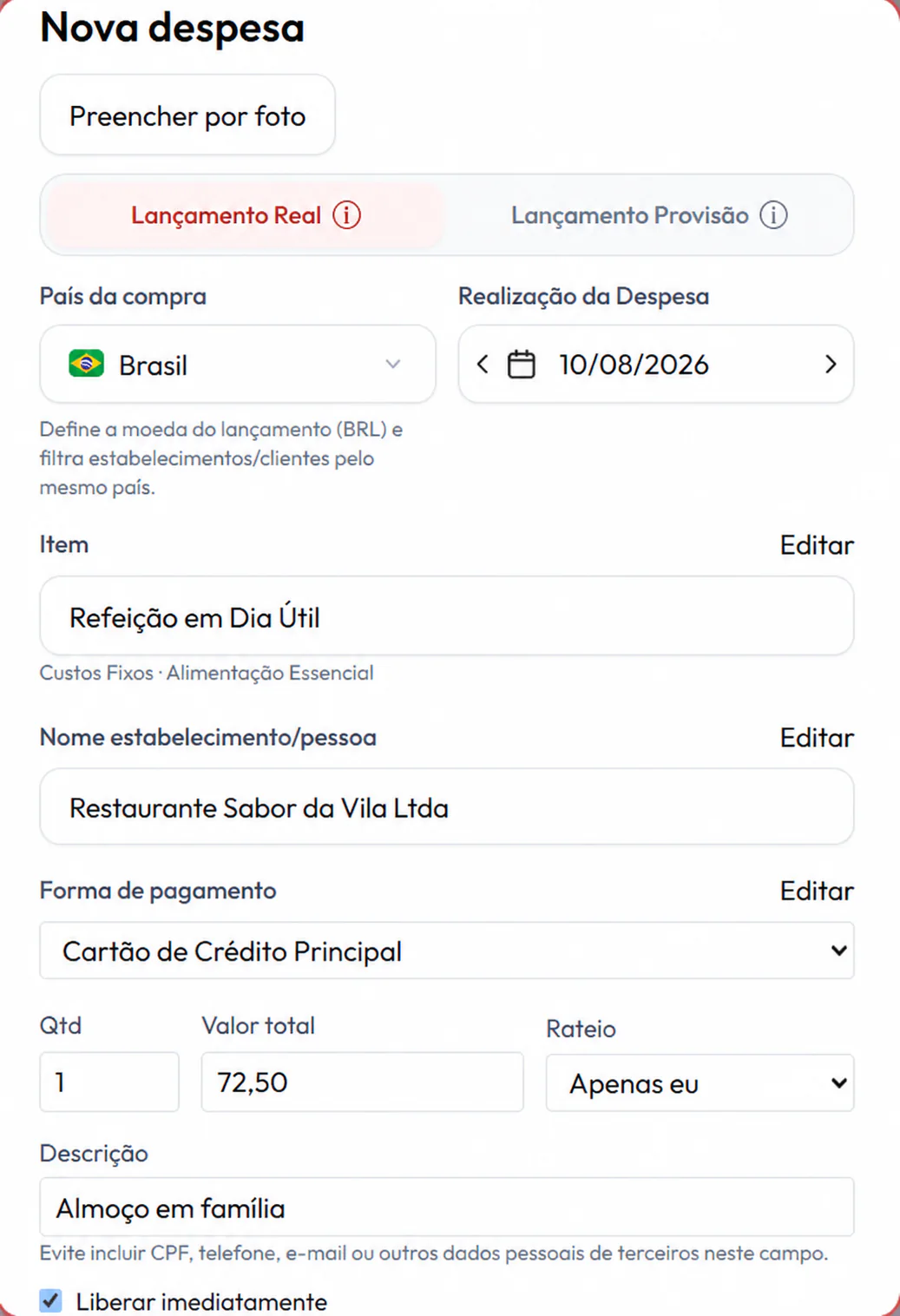
Everything above works on paper — the cost is manual upkeep. ClariFin exists to take that weight: guided logging captures the expense with account, payment method, category and split in seconds; bills, installments and due dates live in the same map; the monthly view compares actual against planned; and the settlement works out on its own who owes what at the close.
For those who want to go further, Clara — the assistant — turns the organized history into insights and suggested next steps, with your consent. ClariFin is free: create your account and put the method into practice with less friction.
Frequently asked questions
Do I need a spreadsheet to organize family finances?
No. The method in this guide works on paper, in a spreadsheet or in an app — what changes is the upkeep cost. A spreadsheet demands discipline to maintain formulas and tabs; an app like ClariFin handles logging, ceilings, installments and the close with less friction.
How often should the family review the budget?
A short weekly check-in (10 minutes: spending, ceilings and what is due) and a full close once a month, adjusting the ceilings for the next one. A budget reviewed once a year drifts away from reality.
What if the family income is variable?
Build the budget on the realistic floor of recent months, not on the average. In months above the floor, the difference goes first to the emergency fund — that way weak months do not turn into debt.
Where do we start if some bills are already overdue?
First, diagnose the real size of the debt (amount, interest and creditor for each). Then prioritize the highest interest ones and negotiate — lump-sum deals or installments that fit the budget. The guide still applies: without a map of income and expenses, any renegotiation becomes a squeeze again in three months.