
How to split expenses as a couple: three models, one example and the monthly settlement
There is no single right way to split a couple’s expenses — there is the way both consider fair and can sustain. This guide compares the three most used models (fifty-fifty, proportional to income and by category), applies all three to the SAME numbers so you can see the difference in practice, and shows how to record who paid what so the month-end settlement runs without friction.
Model 1 — Fifty-fifty: simple, not always comfortable
The simplest rule there is: each person pays half of everything that belongs to the household. Easy to calculate, easy to check, and perceived as fair when incomes are close.
The limit shows up when incomes differ: the same half that weighs little on the higher earner can eat almost the entire salary of the lower one — and then the formula’s "equality" becomes inequality of breathing room. If that is your case, look at the proportional model before settling.
Model 2 — Proportional to income: each at their own scale
Here each person contributes in proportion to what they earn. The formula in plain language: add both incomes; divide each income by the total — that is each person’s percentage; apply the percentage to the household total.
The practical effect is elegant: under the proportional model, both commit the SAME fraction of their own income to the household. If the household costs half of the combined income, it costs half of each income — the breathing room stays proportional on both sides.
The catch is upkeep: income changed (a raise, a new job, a period without income), the percentage changes with it. The agreement needs an agreed review, not a silent adjustment.
Model 3 — By category: each owns a part
In this model, instead of a percentage over the total, each person takes on whole categories: one pays rent and internet, the other pays groceries and utilities. It works well for couples who prefer autonomy — each manages their own bills, with no monthly transfer between them.
The risks: categories do not grow at the same pace (rent adjusts once a year; groceries climb every month), and without a joint look the split can drift out of balance without anyone noticing. If you choose this model, add up from time to time how much each is actually paying — and compare it with what both consider fair.
The same example under the three models
Júlia earns 6,300 and Caio earns 2,700 — together, 9,000. Household expenses for the month: rent 2,100, utilities 600, groceries 1,200, internet and streaming 300, dinner for two 300. Household total: 4,500.
Fifty-fifty: 2,250 each. For Júlia that is 36% of her income; for Caio, 83% — almost nothing is left for his individual expenses. The arithmetic works, the month does not.
Proportional: Júlia’s income is 70% of the total (6,300 out of 9,000) and Caio’s is 30%. Júlia contributes 3,150 and Caio 1,350. Note the symmetry: the household costs 50% of the combined income — and exactly 50% of each income (3,150 out of 6,300; 1,350 out of 2,700).
By category: Júlia takes rent + internet/streaming (2,400) and Caio takes groceries + utilities + dinner (2,100). In practice, a 53/47 split — between the two previous models. Fair? It depends on what the two of you think; now, at least, the number is on the table.
The month-end settlement
At the close, there is a single calculation: compare what each person PAID with what each one OWED under the rule — the difference is the settlement. In the proportional example: Júlia paid rent + internet (2,400), but her share was 3,150; Caio paid groceries + utilities + dinner (2,100), with a share of 1,350. Júlia transfers 750 to Caio and the month balances.
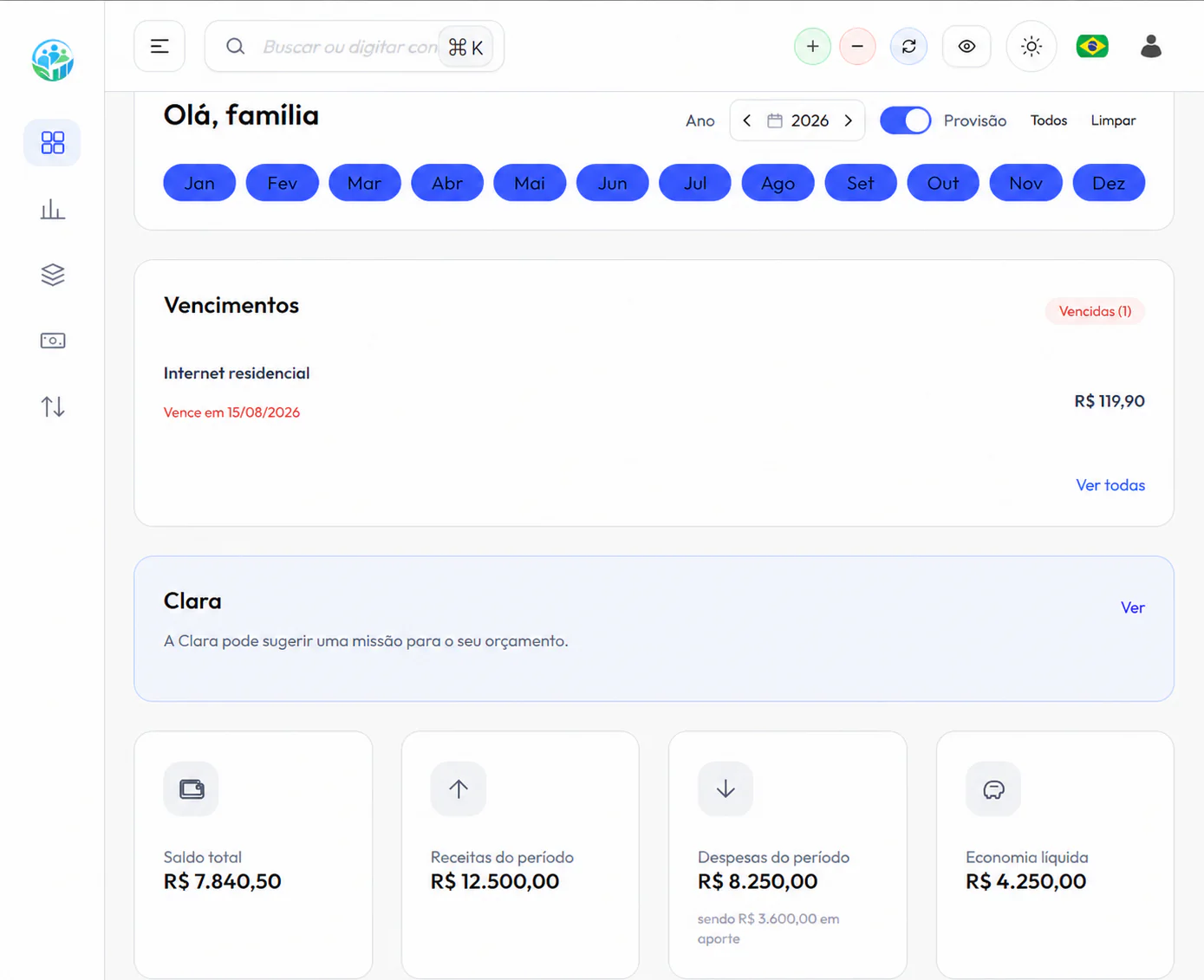
Done by hand, that calculation is half an hour of statements and "do you remember who paid this?" messages. With the records up to date, it is a ready number — ClariFin shows the month’s settlement calculated, and the transfer becomes a 30-second gesture.
Common mistakes — and the conversation that avoids them all
The stumbles repeat: choosing the formula without defining the boundary (then every purchase becomes a debate about "is this a household expense?"); treating the agreement as permanent (income changes, a child arrives, rent goes up — a good split is reviewed); leaving one person as the official accountant (whoever records everything alone accumulates work AND narrative power); and using the settlement as a scoreboard of who spends too much.
The vaccine is a short, recurring conversation — at the monthly close, with the numbers on the table: does the rule still make sense? Has any expense moved sides of the boundary? Is anyone uncomfortable? A good method is not the most sophisticated one; it is the one both understand, accept and can review without drama.
Frequently asked questions
What is the fairest way to split a couple’s expenses?
There is no universal answer. Fifty-fifty is perceived as fair when incomes are close; the proportional model preserves the same relative breathing room when they differ; by category favours autonomy. Fair is the model both choose aware of the numbers — and review when life changes.
What if the income gap is very large?
The proportional model usually eases exactly that case: each commits the same fraction of their own income. In this guide’s example, fifty-fifty would consume 83% of the lower earner’s income; proportionally, both sit at 50%.
How does the split work if one of us has no income?
The agreement must be reviewed together: the proportional model takes the percentage of whoever has no income to zero by definition, and the couple decides whether non-financial contributions (running the home, caring for children) enter the agreement. What matters is that it is an explicit decision by both, not a silent build-up of internal debt.
Do we need to settle the differences every month?
It is the healthiest rhythm: a monthly settlement keeps differences from snowballing and keeps the money conversation short and frequent. With the records of who paid and who took part up to date, the amount comes out ready at the close.