
Financial control for couples: shared money without losing clarity
Living together mixes the money: rent, groceries, cards, installments — and the question that keeps coming back at the end of the month: who paid what, and how much does one still owe the other? A spreadsheet works for the first few weeks, but it demands upkeep, has formulas that break, and turns one of you into the household’s 'official accountant'.
ClariFin is a personal and family finance app built for exactly this routine: each person logs what they spent, the app separates what is individual from what belongs to the household, applies the agreed split and shows the suggested settlement when the month closes.
How to organize money together
The first step is not opening a joint account — it is creating visibility. Most money arguments between couples do not start with a big expense, they start with an invisible one: one pays for groceries without logging it, the other covers the card bill without saying so, and by the end nobody knows whether the split was fair.
Good shared control starts with three simple agreements: what counts as a household expense (and enters the split), what stays individual (and stays out), and the splitting rule — fifty-fifty or proportional to income. Once that is settled, the rest is logging at the moment of spending: who paid, which account it came from, and whether it belongs to the household or to one person.
In ClariFin those agreements become family settings: the people in the household, who is responsible and the split percentages are recorded once and apply to every later entry — no monthly spreadsheet recalculation.
Individual accounts versus household expenses
A couple does not need (and often does not want) to merge everything. The pattern that works best is each person keeping their own accounts and cards, with the family living as a layer on top: expenses marked as household enter the shared view, everything else stays individual.
ClariFin supports both designs from signup: you can use it alone (individual model) or as a joint budget, with each person having their own login. Bank accounts, wallets and cards remain personal — the app does not move money and does not require a joint account; it organizes the information so decisions can be made together.
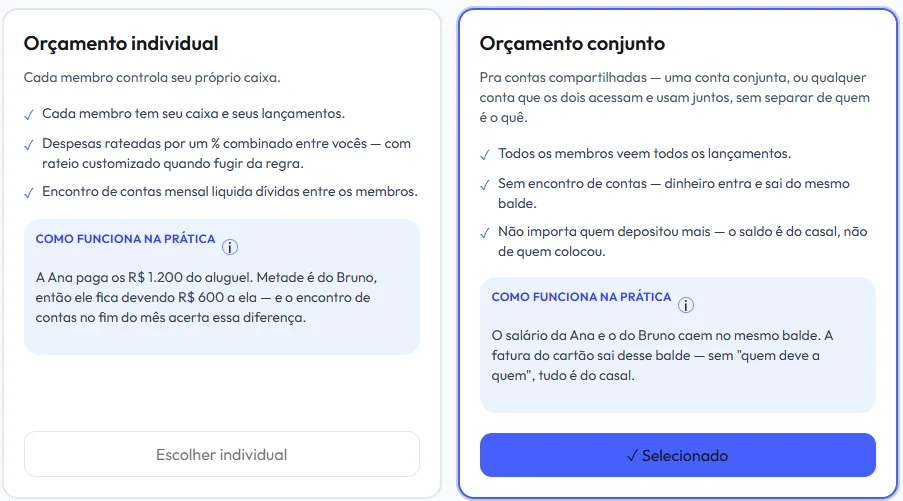
Proportional splitting and the settlement
Fifty-fifty is only fair when incomes are similar. When they are not, proportional splitting is usually the healthier agreement: if one earns 6,000 and the other 4,000, the household can be split 60% and 40% — each contributes at their own scale.
In ClariFin the agreed percentage is saved on the family and applies to shared entries; specific expenses can carry their own split. Through the month the share is calculated on every entry; at closing, the settlement shows a single number: how much one needs to transfer to the other for the month to balance — no side notebook.
Privacy between the people at home
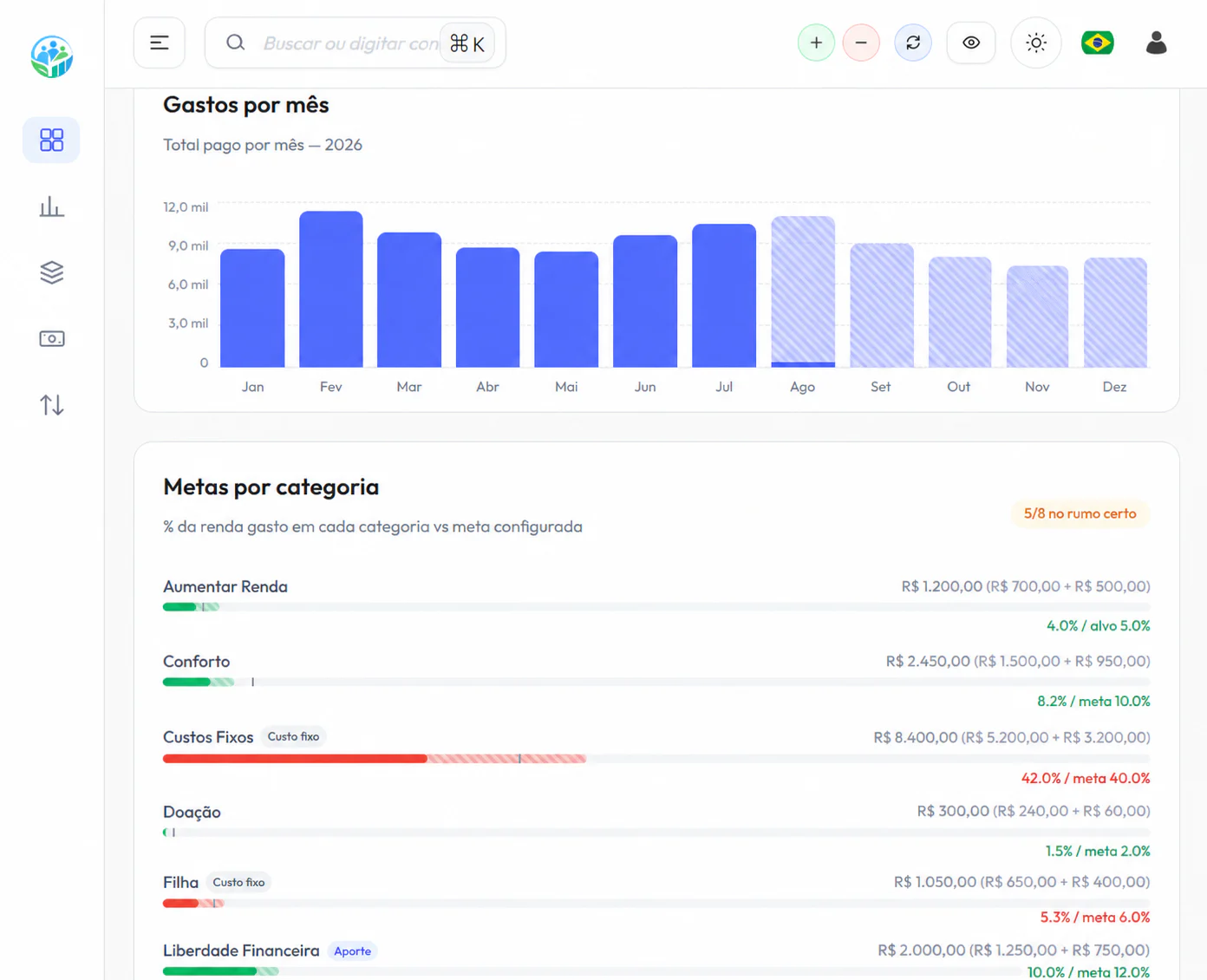
Sharing a life does not mean exposing every coffee. A good system for couples must separate what belongs to the household — visible to both — from what is personal.
In ClariFin the model chosen by the family defines what is shared, and individual entries can stay restricted to whoever recorded them. Each person has their own login, with access security (including two-factor) and privacy controls aligned with Brazil’s data protection law — the data is yours, with export and deletion available.
How to start, in practice
Start simple: set up the family and the splitting rule, register the accounts and cards each of you uses, and agree to log household expenses as they happen — it takes seconds and spares you the painful month-end reconstruction.
In the first weeks the goal is not perfection, it is a snapshot: seeing the household’s real spending pattern. From there, the monthly close with the settlement becomes a short routine — and Clara, the assistant, turns that history into insights and possible next steps for your budget, with your consent.
Frequently asked questions
Do we need to merge our bank accounts to use ClariFin?
No. Each person keeps their own accounts and cards — ClariFin does not connect to your bank and does not move money. It organizes the household records: what each of you paid, how the expense is split and how much is left to settle.
Does ClariFin calculate the split automatically?
Yes. The family rule (fifty-fifty or income-proportional percentages) is saved and applies to shared entries; specific expenses can have their own split. The monthly share and the suggested settlement are calculated by the app.
Can each of us see everything the other spends?
Only what belongs to the household. The model chosen by the family defines what is shared, and individual entries can remain visible only to whoever recorded them.
How much does it cost for a couple?
Yes. ClariFin is free. You can create an account and use the available features at no charge.