How to build capital to invest: what companies can teach us about budgeting
Why does a company go public? In a primary offering, it accepts new shareholders so that money enters the business and finances projects, expansion or a change in its debt profile. The investor provides capital today because they expect to share in future results — while also accepting the risk that the plan may not work.
A household does not hold an IPO, of course. But the logic offers a useful lesson: future projects require capital, and capital must be built before it can be allocated. In personal finance, the budget is the process that turns income into a recurring surplus; the emergency fund protects that surplus; and regular contributions build the capital that can later finance goals and investments.
Marcio RosaPublished on:
1. Why companies go public
Companies grow when they can finance projects that expand their ability to produce, sell, innovate or serve new markets. That financing can come from retained profits, debt, private investors or the capital markets.
When a company issues new shares in a primary offering, investors’ money enters the company’s cash position. In return, the new shareholders receive an ownership stake. There is no mandatory monthly installment as with a loan, but the capital is not free: the previous owners share part of the business, and the company takes on obligations involving governance, transparency and accountability.
This is the central point in Raul Sena’s explanation that inspired this guide: for a company with sound projects, bringing in partners interested in its growth can be an alternative to relying on large interest-bearing debt. The economic purpose is to connect those who have capital with those who can use it to create more value.
2. Not all IPO money goes to the company
The distinction between primary and secondary offerings avoids a common misunderstanding. In a primary offering, new shares are issued and the proceeds go to the company. In a secondary offering, founders, funds or other shareholders sell existing shares; in that case, the money goes to the seller, not to the company.
An offering may combine both parts. Before concluding that an IPO is financing growth, check the intended use of proceeds and the offering documents. The stated purpose matters, but the company’s ability to execute the plan and the risks of the business matter just as much.
3. Income, surplus and capital are different things
Income is the money that comes in. Surplus is what remains after the period’s expenses and commitments. Capital is the accumulated surplus that has been separated to finance something in the future. Confusing these concepts leads many people to believe that earning more is enough to build wealth.
Higher income increases the potential capacity to accumulate, but it does not guarantee capital. If every raise becomes higher consumption, the surplus remains zero. A budget gives the money a destination before the month decides on its own: how much supports the household, how much protects the family and how much will be accumulated for long-term goals.
The comparison with a company ends here: a family does not sell ownership or look for shareholders. It forms its own capital by sustainably and repeatedly spending less than it earns.
4. Before investing, put your money in the right order
Investing without a budget often creates a bad cycle: someone contributes in one month, discovers a forgotten bill in the next and has to withdraw the money. The problem is not necessarily the investment, but the lack of a structure separating everyday money, protection and long-term goals.
A practical order is to keep essential expenses current; map and address debts, especially high-interest debt; build an emergency fund suited to the household; and only then increase contributions to medium- and long-term goals. These stages can overlap in some cases, but they should not compete invisibly.
An emergency fund is also capital, but it has a specific purpose: protection. It must prioritize safety and liquidity. Capital intended for longer-term investments can have different characteristics, according to the goal, time horizon, liquidity needs and risk tolerance.
clarifin.online
5. The budget is the engine that generates contributions
A budget does not create money; it reveals choices and turns intention into a rule. Start by recording net income, fixed expenses, variable spending, existing installments and debt payments. The difference shows the current capacity to accumulate — even when the result is uncomfortable.
Then choose a contribution that fits the real month. A smaller recurring amount is usually more useful than an aggressive target abandoned after the first unexpected expense. Treat that contribution as part of the plan, monitor it during the month and adjust category limits when the numbers do not balance.
The formula is simple: income minus the cost of everyday life, commitments and a safety margin equals the capacity to accumulate. The difficult part is not understanding the formula; it is keeping the numbers visible so you can decide what to change without pretending that a necessary expense does not exist.
6. Example: from monthly surplus to accumulated capital
Imagine a family with monthly net income of BRL 8,000. After mapping its routine, it assigns BRL 4,200 to fixed expenses, BRL 1,800 as the ceiling for variable expenses, BRL 600 to installments and insurance, and BRL 400 as a margin for unexpected monthly costs. That leaves BRL 1,000 of planned accumulation capacity.
While the emergency fund is still being built, the family directs BRL 700 to that protection and BRL 300 to a long-term goal. Once the fund reaches its target, the BRL 700 can receive another destination. Without considering any return, twelve contributions of BRL 1,000 create BRL 12,000 of capital in one year.
The example highlights an important idea: at the beginning, the habit of contributing usually matters more than return. Investment performance matters, but it works on the capital that managed to arrive and remain invested.
7. Investing means choosing where capital will work
When you invest, you move from simply accumulating money to allocating capital. Depending on the asset, those funds may finance a government, a financial institution, a company, a real-estate project or an ownership stake in a business. Expected return compensates for different combinations of time, risk and liquidity.
That does not mean every productive investment will be good for your wealth. A small company may grow significantly or fail to execute its plan; a share price may fall; a bond may be unsuitable for a short-term goal. Building capital is the first part. The second is studying where to allocate it without concentrating risks that your financial life cannot support.
This guide is educational and does not recommend assets. Investment choices should consider your goals, time horizon, risk profile, costs, taxes and need to access the money.
8. Checklist to start building capital
Use this sequence to turn the concept into a routine:
Record the household’s actual net income, including changes from one month to another.
Map fixed and variable expenses, installments and debts before setting the contribution.
Choose limits that describe real life and monitor them during the month.
Keep a margin for unexpected expenses so that every variation does not trigger a withdrawal.
Build an emergency fund that prioritizes safety and liquidity.
Automate a sustainable monthly contribution and increase it when real room appears in the budget.
Separate each goal by time horizon before choosing where to invest.
Review the budget at month-end and redirect efficiency gains to contributions.
How ClariFin supports this process
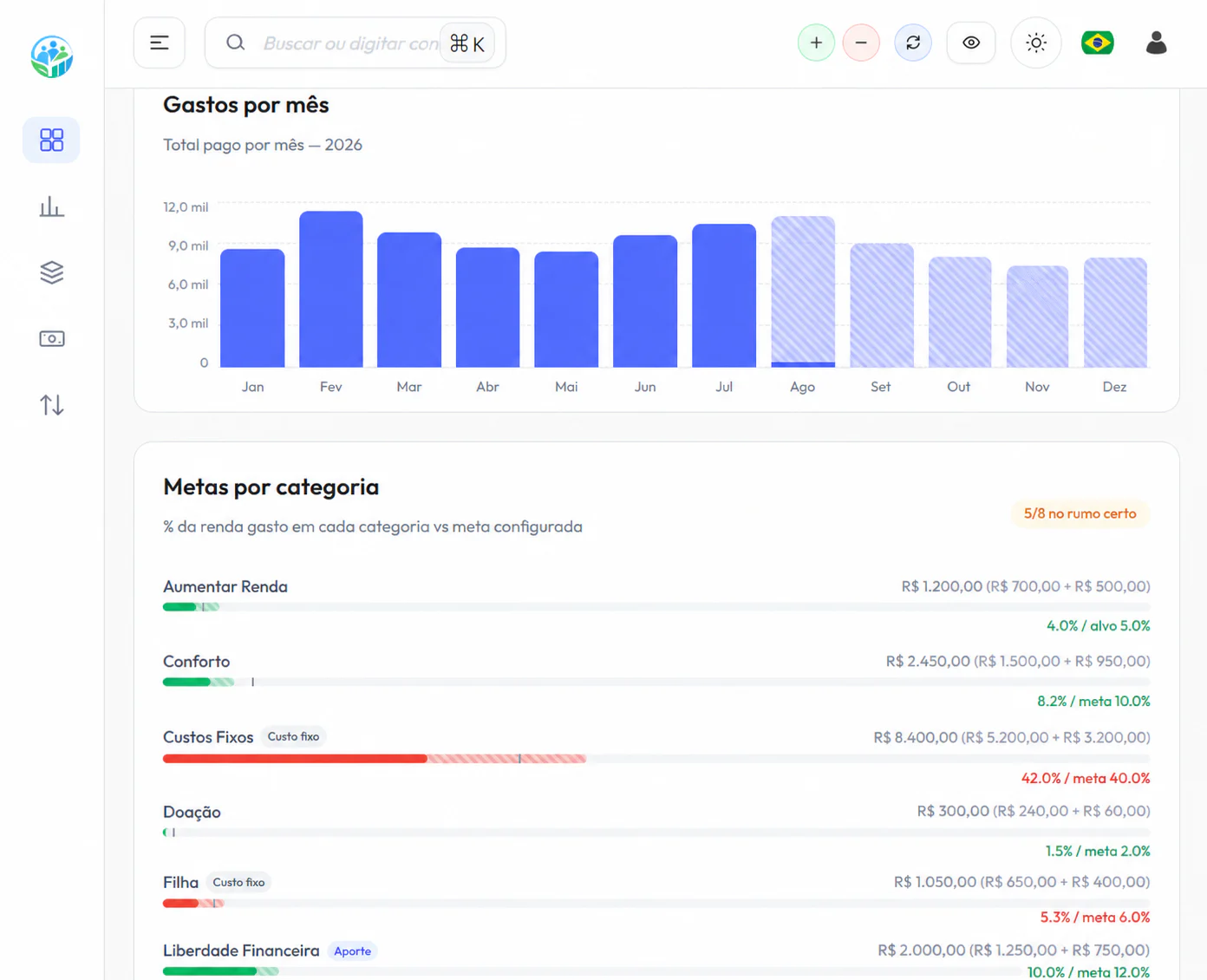
ClariFin does not choose investments or promise returns. Its role comes earlier: organizing income, expenses, accounts, cards and installments to show how much income is already committed and how much can realistically be given a future purpose.
With everyday finances recorded and the month closed, it becomes easier to distinguish an occasional surplus from a recurring capacity to contribute. That clarity turns “I want to invest” into a monthly decision that fits the family budget.
Frequently asked questions
Does the money from an IPO always go to the company?
No. In a primary offering, the company issues new shares and receives the proceeds. In a secondary offering, shareholders sell existing shares and receive the money. An offering may also combine both.
Are saving and investing the same thing?
Not exactly. Saving means separating and preserving resources; investing means allocating that capital to an asset with a particular combination of risk, time horizon, liquidity and expected return. An emergency fund, for example, requires different characteristics from a long-term goal.
How much of my income should I invest each month?
There is no universal percentage. The amount must fit after essential expenses, commitments, debt management and protection against unexpected events. Starting with a sustainable contribution and increasing it over time is better than setting a target that forces frequent withdrawals.
Do I need to pay off every debt before investing?
High-interest debt usually deserves priority because it may grow faster than the expected return of many investments. Even so, the order depends on rates, terms and the need to maintain a minimum emergency fund. In complex situations, seek independent financial guidance.
Does ClariFin recommend stocks or other investments?
No. ClariFin organizes everyday finances to clarify commitments and contribution capacity. Investment selection remains the user’s decision, based on goals, time horizon and risk.