
Emergency fund: why it matters, how to build it and how to track it
An unexpected expense rarely tells you when it will arrive. It may be a loss of income, an essential repair, a health emergency or a family cost that does not fit the month. Without financial protection, the unexpected event becomes debt or forces you to sell an investment too early — possibly during a downturn.
This is the central message of Raul Sena’s video that inspired this guide: buying investments before building an emergency fund leaves the entire strategy vulnerable to the first setback. The fund is not designed to seek the highest return; it exists to give you time to reorganize without turning urgency into expensive debt.
1. Why an emergency fund comes before investing
Medium- and long-term investments work best when they can remain invested for the planned period. Without a fund, any unexpected event may force a withdrawal, interrupt contributions or create credit-card and overdraft debt. The problem is not only financial: having no time to decide increases the chance of accepting expensive credit or selling an asset under unfavorable conditions.
The emergency fund creates that time. It keeps essential expenses covered while the household replaces lost income, handles an urgent need or adjusts its budget. Safety and quick access to the money therefore matter more than chasing the highest possible return.
A fund also protects the other goals. Money for a home down payment, retirement or an investment does not have to perform two jobs at once. Each amount receives a purpose, time horizon and rule for use.
2. An emergency fund and a store of value are not the same thing
An emergency fund is money separated for unexpected events and must remain available with a low risk of loss. A store of value is an asset expected to preserve purchasing power over time. An asset may serve the second purpose while still fluctuating too much or taking too long to turn into cash — poor characteristics for an emergency.
The video discusses an emergency fund. For this purpose, the main question is not “which asset could appreciate the most?”, but “can I access the money when I need it without being forced to sell at a loss?”. That distinction keeps the household’s protection in a place compatible with its purpose.
3. How much to keep in an emergency fund
Brazil’s Investor Portal estimates a fund equal to 6 to 12 months of expenses, but the exact amount depends on the household. Stable income, two earners and predictable expenses may support a target closer to the lower end. Variable income, dependents, self-employment or a single source of income call for a larger margin.
Base the calculation on essential expenses, not income. Add housing, food, health care, transportation, education, insurance, utilities and installments that would continue during a crisis. Expenses that could be suspended do not necessarily need the same coverage.
Example: with average essential costs of BRL 3,000 a month, six months equal BRL 18,000 and twelve months equal BRL 36,000. A BRL 19,200 fund covers 6.4 months. The number of months is more useful than looking only at the balance because it adjusts to changes in the cost of living.
4. How to build the fund without relying on what is “left over”
Turn the emergency fund into a budget commitment. After recording income, essential expenses, installments and debts, choose a monthly contribution that fits the real month. A sustainable amount repeated over time usually builds more protection than an aggressive target abandoned after the first difficulty.
If the full target feels distant, work in stages. The first milestone may be one month of essential expenses, followed by three months, then six and, if your situation requires it, twelve. Extraordinary income, such as part of a year-end bonus or extra work, can accelerate progress without compromising the routine.
- Calculate the essential monthly cost using real months, not an idealized estimate.
- Choose the number of months according to income stability and family responsibilities.
- Set an achievable first milestone and a review date, not an impossible promise.
- Place the contribution at the beginning of the budget and monitor the rest of the month with category limits.
- Direct part of extraordinary income to the fund until it reaches the target.
- After using the fund, make rebuilding it a temporary budget priority.
5. Where to keep it: liquidity and safety before return
Because an emergency has no scheduled date, the fund needs high liquidity, low risk and no lock-up period. The Investor Portal advises looking for alternatives that provide daily access and match the protection objective. Even products classified as fixed income may have different rules, terms, taxes and risks; read the conditions before choosing.
Return still matters as a way to reduce loss of purchasing power, but it should not compromise access to the money or expose the fund to fluctuations that could force a sale at a loss. Split the decision into two questions: are the funds safe for their intended purpose? Will they be available when the household needs them?
This content is educational and does not recommend a specific financial product. Compare risk, liquidity, costs, taxes and guarantees and, if necessary, seek independent professional guidance.
6. When to use it — and when not to
An emergency combines necessity, urgency and a lack of room in the current budget. Loss of income, essential health care, a repair required to keep working or replacement of an essential item are possible examples. A sale, trip, gift or predictable purchase does not become an emergency just because the money is available.
Set the rule before the unexpected event: which situations authorize use, who takes part in the decision and how the fund will be rebuilt. In a household, this conversation prevents the same balance from looking like protection to one person and free money to another.
7. How to set up the emergency fund in ClariFin
ClariFin does not hold or invest the money. It records how much of each account balance you consider reserved for unexpected events and uses that information to monitor the household’s financial protection.
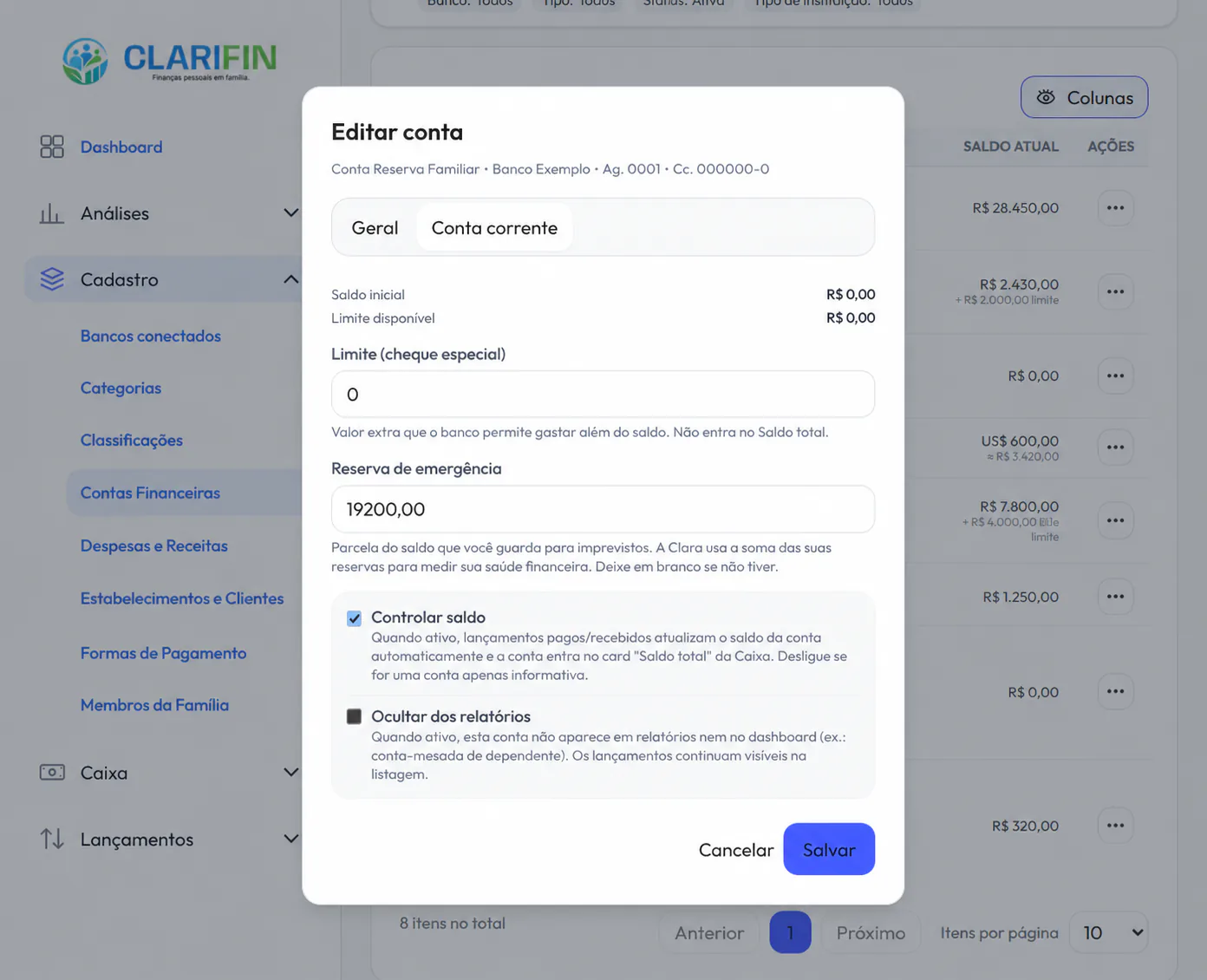
Under Registration → Financial Accounts, edit the account where the fund is kept and enter only the portion of the balance assigned to that purpose in the “Emergency fund” field. If the protection is spread across accounts, record the reserved portion in each one. Do not include credit-card limits, overdraft facilities, expected income or money that is not yet available.
In the demo screen, the Family Emergency Fund Account has BRL 19,200 assigned to emergencies. The data is fictional and only illustrates where the setting is entered.
8. How to track coverage and keep the target current
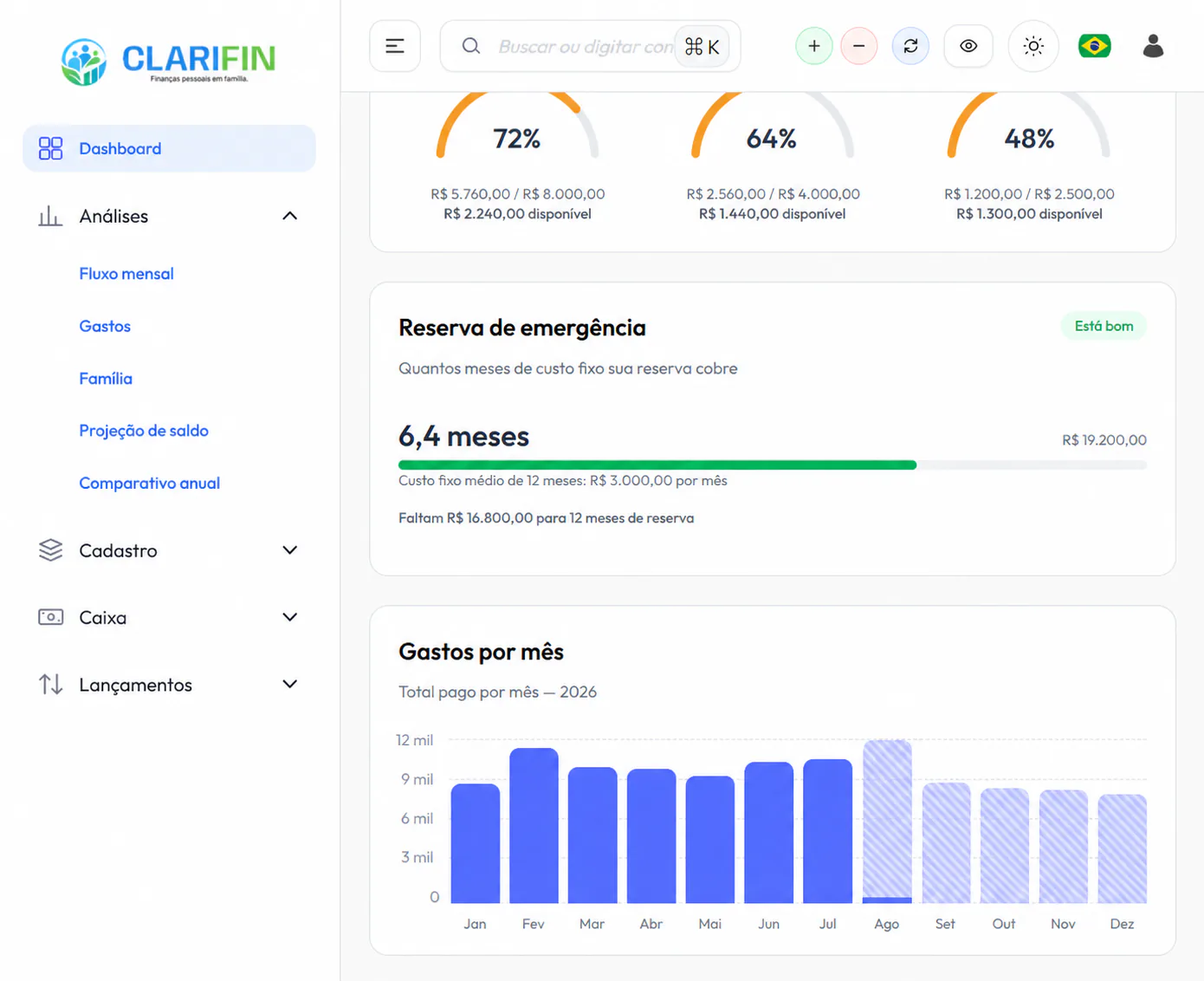
On the dashboard, ClariFin adds the amounts entered as emergency funds and compares the total with the average fixed cost over the previous 12 months. The result appears as months of coverage, together with the amount still needed to reach twelve months. This turns an isolated balance into a measure that follows the household’s reality.
In the example, BRL 19,200 divided by an average fixed cost of BRL 3,000 represents 6.4 months. Reaching twelve months would require BRL 36,000, leaving BRL 16,800 to go. If essential spending increases or decreases, coverage changes — so review entries, categories and reserved amounts during the monthly close.
The indicator helps monitor the plan, but the household still chooses the target and where to keep the money. ClariFin organizes the information; it does not replace risk analysis or investment decisions.
9. Checklist to start today
Use this sequence to turn intention into measurable protection:
- List the essential expenses that would continue even after a loss of income.
- Calculate the monthly average from real entries and choose a coverage target.
- Separate the emergency fund from other goals so the same money is not counted twice.
- Prioritize low risk and liquidity compatible with an unscheduled need.
- Choose a realistic monthly contribution and progress through one-, three-, six- and twelve-month milestones.
- Record in ClariFin the amount effectively reserved in each account.
- Monitor months of coverage and review the target whenever essential costs change.
- Create a household rule for use and rebuild the amount after an emergency.
Frequently asked questions
Are an emergency fund and a store of value the same thing?
No. An emergency fund prioritizes quick access and low risk to cover unexpected events. A store of value is associated with preserving purchasing power over time, and such an asset may not offer the liquidity or stability required in an emergency.
Should the fund cover 6 or 12 months of expenses?
Brazil’s Investor Portal estimates a range of 6 to 12 months of expenses. The target depends on the stability and number of income sources, the number of dependents, the predictability of expenses and the ability to recover after losing income.
Should I calculate the fund from income or expenses?
Use the essential expenses that would need to continue during a crisis. Income helps determine contribution capacity, but the fund exists to sustain the essential routine for a certain number of months.
Can I count a credit-card or overdraft limit as an emergency fund?
No. A limit is credit and may generate interest; it is not available wealth. Record only resources that already exist and have been separated for this purpose.
Does ClariFin move or invest the emergency fund?
No. ClariFin organizes and monitors the information. You enter how much of the account balances is reserved, and the dashboard calculates coverage in months from the recorded average fixed cost.