
How to reach your first million: a realistic plan starts with the budget
Reaching your first million sounds like an investment question, but it starts somewhere else: understanding your financial position, controlling the cost of your routine and creating room to contribute every month. Without that foundation, even a good return works on little capital — or the money must be withdrawn at the first setback.
The Bruno Perini video that inspired this guide arranges the journey into stages: face debts, record spending, build a budget and reserve part of your income for the future. Here, those ideas become a practical method with an additional question that changes how consumption feels: how many hours of your life were required to pay for each purchase?
First-million simulator
Compare what could happen over 10, 20 or 30 years. The calculation runs only in your browser: no value is sent or stored.
Simulation result
At the entered pace, the goal would be reached in approximately 42 years 1 month.
Monthly contribution needed for each horizon
| Horizon | Estimated monthly contribution |
|---|---|
| 10 years | $7,171 |
| 20 years | $3,059 |
| 30 years | $1,728 |
This is an educational simulation in today’s money, not a forecast or investment recommendation. Returns are not guaranteed and actual results may vary.
1. The first million starts before investments
Wealth does not come from one financial product. It results from a positive gap between income and spending, repeated for long enough and protected from predictable interruptions. Investing helps preserve and grow capital, but it cannot replace the ability to form that capital.
This also explains why a high income does not guarantee wealth. When every raise becomes a lifestyle upgrade, contribution capacity remains small. Part of income growth can improve life today; another part needs to protect future goals and freedom.
For someone who can barely cover essential expenses, the first objective may not be one million. It may be stabilizing the budget, leaving a debt behind or increasing income. A realistic plan respects the starting point instead of turning a distant goal into guilt.
2. Build a financial diagnosis without shortcuts
Before setting contributions, gather the numbers already controlling your life: income actually received, available balance, fixed expenses, variable spending, installments, loans, financing and card bills. For each debt, record the balance, rate, payment and remaining term.
Then answer five questions: how much comes in each month; how much goes out on average; how much of the routine is fixed or variable; how much is saved; and how long the household would keep running if income stopped tomorrow. The last answer shows how dependent the budget is on the next paycheck.
The diagnosis is not meant to judge past choices. It creates a verifiable starting point. Without it, any contribution goal is only an expectation; with it, you can decide what needs to change first.
3. Stop the debts that block the plan
Debts are claims on future income. When they charge high interest, they can grow faster than the wealth you are trying to build. Rank them from the highest rate to the lowest, avoid adding new installments and evaluate renegotiation, refinancing or early repayment according to cost, term and household security.
The rule is not to repay every loan without doing the math. Compare the effective cost of debt, risks, required liquidity and plausible net return of alternatives. Rates and conditions change; a decision that works today may stop working in another economic cycle.
Even during reorganization, a minimum safety buffer may be necessary so that an unexpected expense does not send the household back to expensive credit. The goal is to stop the leak and build a routine that does not require new debt to operate.
4. Record 30 days and discover the real cost of your routine
For at least 30 days, record everything: housing, groceries, transport, pharmacy, subscriptions, fees, delivery, leisure, transfers, cards and installments. Small purchases count too. The goal is not to monitor every coffee forever, but to build a complete enough sample to see patterns.
One month does not represent every expense in a year. Taxes, tuition, insurance, maintenance and gifts appear at specific times. After the first diagnosis, turn those predictable costs into monthly provisions so they do not look like emergencies when they arrive.
Recording changes the conversation from “I think nothing is left” to “these groups consume the income.” That difference makes it possible to reduce waste without pretending that necessary expenses can disappear.
5. Turn spending into visible priorities
Classify spending simply. Essential keeps life running, such as housing, food, transport and basic bills. Important supports health, education, work and meaningful goals. Discretionary spending can be reduced or postponed without damaging the household structure.
These categories are not universal. A car may be a work tool for one household and optional comfort for another. The value lies in the discussion: when each expense has a role, it becomes easier to protect what matters and consciously choose what to reduce.
A budget is not designed to remove pleasure. It allows spending without hiding the price that a choice charges other goals. Planned leisure is part of life; automatic consumption is what takes the future’s space without a clear decision.
6. Set goals that compete with consumption
A goal turns “I want to save” into an amount, deadline and priority. It may be paying a debt, building an emergency fund, financing education, changing homes or pursuing financial independence. Different goals require different terms and levels of liquidity.
Before choosing rigid percentages, observe real life. Set category limits, leave room for variation and create a sustainable contribution. The best starting point is not the most aggressive number, but the one that still exists when the month becomes less comfortable.
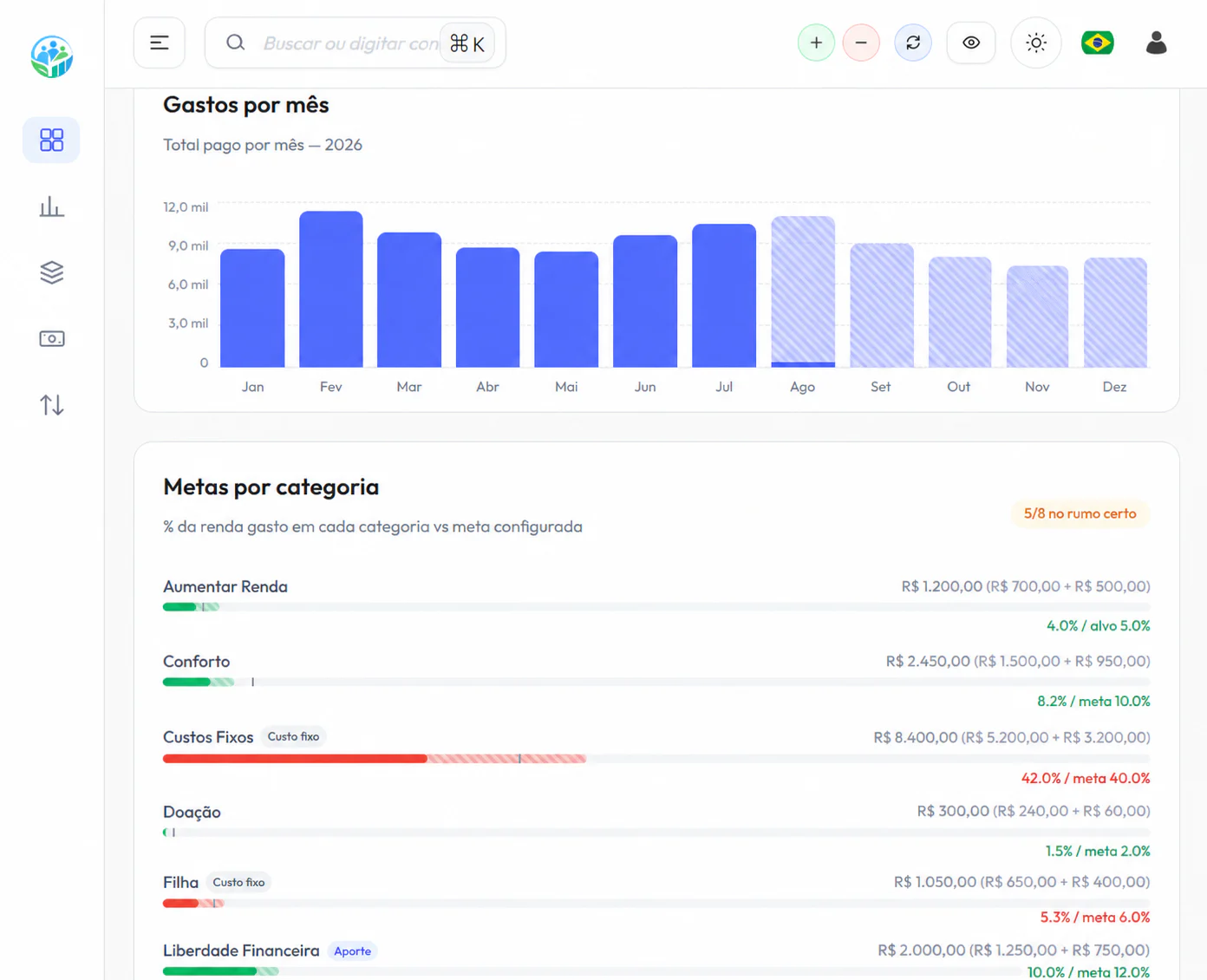
In ClariFin, the spending and category-goal dashboard brings the plan close to actual results. Across the year, you can see which areas are on track, which exceeded the limit and where there is real room to increase contributions.
7. Convert a purchase price into life hours
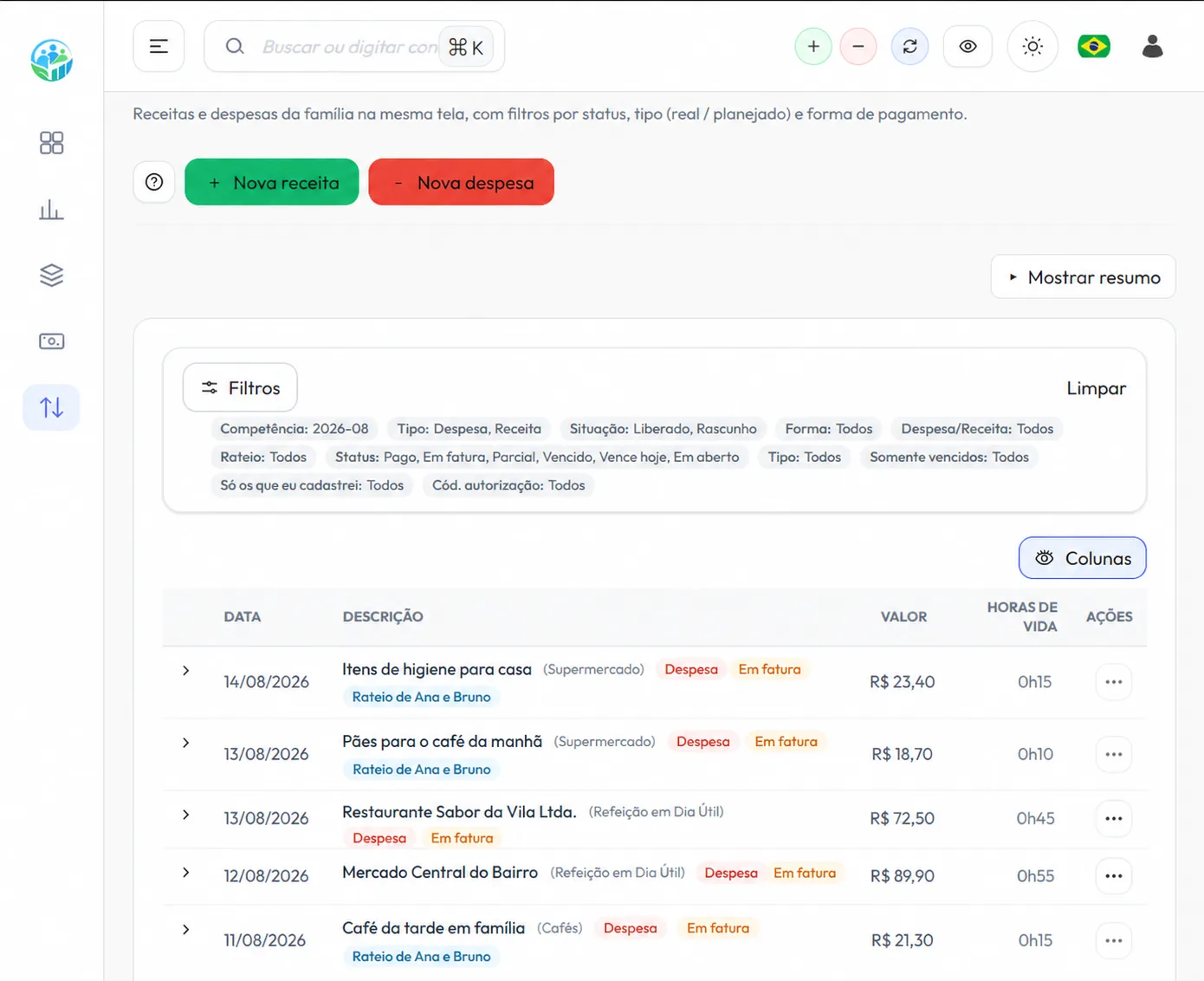
Price shows how much money leaves the account. Life hours show how much work time was required to generate that amount. If your estimated hour is worth R$ 80, a R$ 400 purchase represents about five hours. The question is no longer only “do I have enough credit?” but “is this choice worth five hours of my time?”
In ClariFin, the estimate uses the average of your share of income received over up to 12 closed months and divides the monthly amount by 220 hours. For shared expenses, the conversion uses your share. The result is an attention reference, not a universal measure of salary, effort or personal value.
Use the column to create a pause before and after a purchase, without guilt. Essential expenses also consume hours and remain necessary. The purpose is to compare consumption and priorities: would I still choose this if I saw the time first; does it move a goal closer or farther away; and will I still value it when the bill arrives?
- Compare recurring purchases: small repeated decisions can consume many days over a year.
- Evaluate the total price, not only the installment: your life time was also committed across future months.
- Consider usefulness, durability and experience: an expensive purchase may be worth the time; a cheap one may be pure waste.
- Do not use the metric to compare people: income, working hours, responsibilities and household contexts differ.
8. Pay your future self first
Someone who waits until month-end to invest depends on a surplus that competes with every earlier decision. An alternative is to separate the contribution when income arrives, as a budget commitment. This does not mean ignoring bills: the amount must fit after the diagnosis and remain compatible with household protection.
Automation reduces dependence on motivation. Start with an amount you can repeat, review it when income or expenses change and direct part of future raises to contributions before absorbing the whole increase into lifestyle.
Consistency is not rigidity. In an emergency month, the plan may change. What matters is distinguishing a conscious exception from a budget that never leaves room for the future.
9. Simulate carefully: contribution, time and return
The time needed to reach a level of wealth depends on initial capital, contributions, time and real net return — after inflation, taxes and costs. In the early years, increasing contribution capacity is usually more controllable than chasing higher returns through risks you may not be able to sustain.
Use the simulator on this page to compare 10-, 20- and 30-year horizons, test contributions and see how much of the result would come from your own capital versus investment growth. Long-term simulations are scenarios, not forecasts: use conservative assumptions and update the plan. The Personal Financial Planning book available through the Investor Portal recommends caution with projections and emphasizes that the rate should be real and net.
Also distinguish a nominal million from one million in today’s purchasing power. The longer the term, the more important it is to account for inflation. A useful goal is not only a round number: it is the wealth required to finance the objectives you defined.
How ClariFin turns the plan into a routine
ClariFin does not promise your first million and does not choose investments. It organizes the stage that comes first: recording income and spending, tracking cards and installments, showing category goals and revealing how much future income is already committed.
With the data in one place, you can close the month, adjust limits, reserve the contribution and check whether real choices remain aligned with goals. The life-hours column adds another perspective: beyond the currency amount, it shows the approximate time each transaction represents to you.
The result is not a shortcut. It is a system for repeating sound decisions for long enough — precisely the least glamorous and most important part of building wealth.
Frequently asked questions
Is reaching the first million realistic for everyone?
The deadline and even feasibility depend on income, cost of living, debt, initial capital and contribution capacity. For many people, the immediate priority will be stabilizing the budget or increasing income. The goal must respect reality and can be divided into smaller milestones.
How much do I need to invest each month?
There is no universal amount. Simulate using the deadline, initial capital and conservative assumptions for real net return. Then compare the required contribution with the budget. A sustainable and growing amount is better than an aggressive target that is quickly abandoned.
Do I need to pay every debt before investing?
High-interest debt normally deserves priority, but the decision depends on rates, terms, liquidity and the need for minimum protection. Compare the effective cost and avoid replacing one debt with another without understanding the total amount.
Are life hours an exact measure?
No. They are an estimate that supports decisions. ClariFin uses income received, up to 12 closed months of history and a 220-hour monthly reference. Working arrangements, passive income, benefits and personal context may change the interpretation.
Does the simulator calculate when I will reach one million?
It estimates a time horizon from the capital, contribution and real net return you enter. The calculation helps compare scenarios, while ClariFin tracks the budget, commitments and goals to reveal contribution capacity. Inflation, returns, taxes, costs and risk can change the outcome, so the estimate is not a guarantee.